
Why Lume Matters
 By Randy·November 10, 2026
When you're collecting vintage watches, the luminous material on the hands and markers (the "lume") is one of the best tools you have for checking a watch's age and originality.
Two things happen to lume over the decades. The glow fades as the radioactive material and the phosphor it excites break down, and the paint itself ages from heat, light and humidity. Together they leave marks that collectors study closely.
A newer collector might see faded or crumbling lume as damage. An experienced one sees a record of how the watch has lived, a clue to whether it's all original, and a big factor in what it's worth.
Condition matters, but with vintage watches originality usually wins. If a watch has been relumed, meaning the old compound was scraped off and replaced with modern paint, its value can drop by 30% to 50%. Serious collectors want the watch the way time left it.
The biggest risks usually aren't cheap fakes. They're clever chemical work, or genuine factory parts that were fitted during a later service. To protect yourself, it helps to know how people get fooled and how to spot it.
Why did vintage watches use lume?
Before backlights, lume was what let you read a watch in the dark. Demand took off during World War I, when soldiers in the trenches needed to read the time at night without striking a match and giving away their position.
By the middle of the century, deep-sea diving and military and commercial aviation made lume a working tool. Divers and pilots relied on the glow of the dial to track time in total darkness.
What type of lume do vintage watches have?
Vintage watches use two main types of lume: radium, and later tritium. Starting in the early 1960s, Swiss dials using tritium were marked at 6 o'clock to show the type and amount of radioactive material. Matching the marking to the production year is one of the best tests of originality.
The radium era (1910s to the early 1960s)
Radium was unregulated and strongly radioactive. Most Swiss brands moved away from it between about 1962 and 1964, and Rolex is generally said to have stopped around 1963. Factories didn't throw away finished parts, though, so radium dials and hands sometimes turn up on watches assembled a year or two after the switch.
Radium dials are usually marked just "SWISS" or "SWISS MADE," with no T. Aged radium tends to turn dark brown or greenish black. Over decades it can also leave a "radium burn," a faint scorch on the dial or crystal where the hands or markers sat.
The tritium era (early 1960s to 1998)
Tritium is a much weaker radioactive source. Dials that used it carry a "T" marking at 6 o'clock:
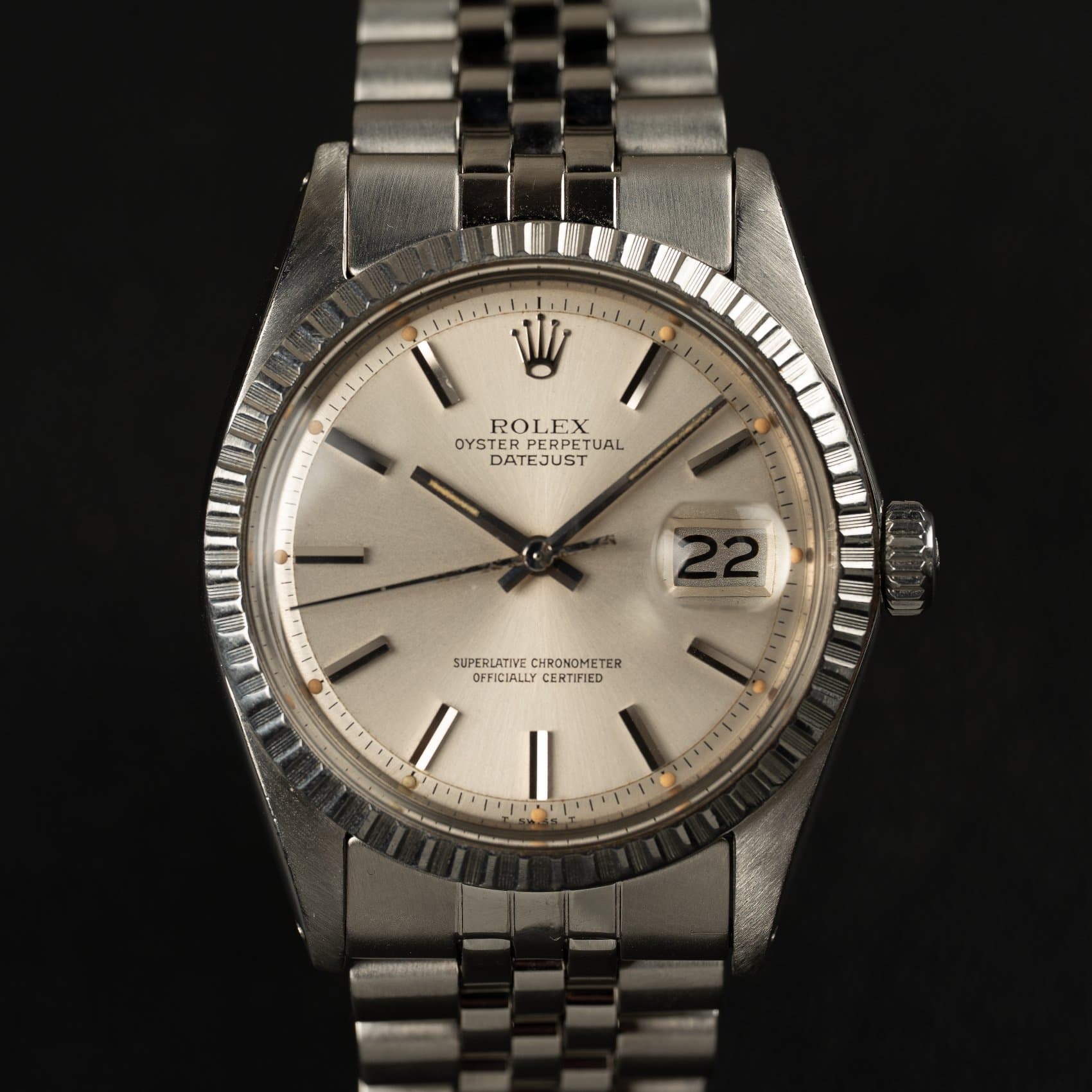
"T SWISS T" or "T SWISS MADE T" means the watch contains no more than 7.5 millicuries (mCi) of tritium. This was standard on dress watches and sports watches with modest amounts of lume.
"SWISS - T < 25" or "SWISS T<25" means no more than 25 mCi. It was used on tool watches with heavy lume plots, like divers and pilot's watches.
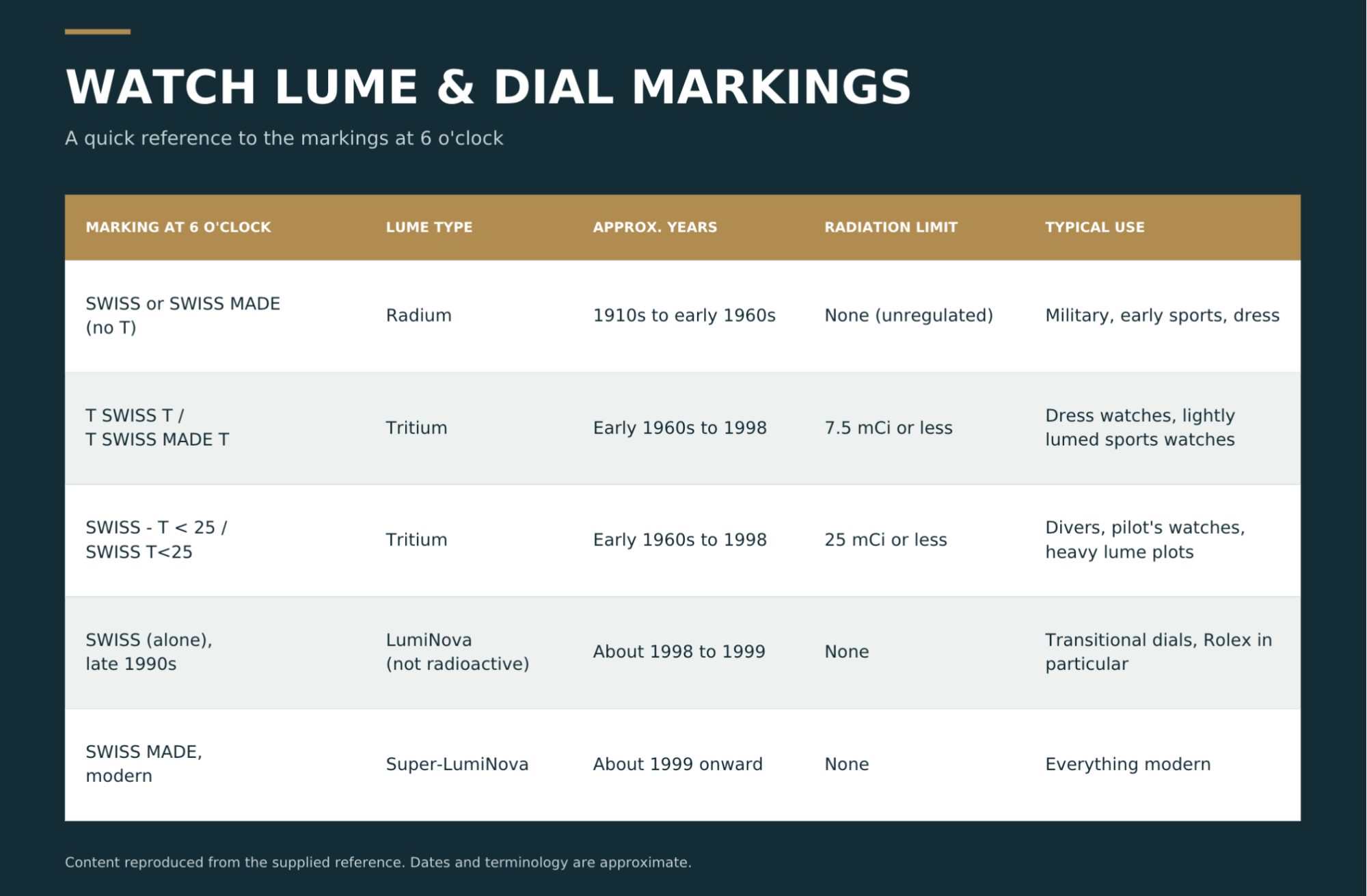
Watch out: a plain "SWISS" signature appears at both ends of this timeline, on radium dials and on the first non-radioactive dials of the late 1990s. The text alone won't tell you which you're looking at. The reference number, the case serial and a Geiger counter will.
What does proper lume look like? Some examples
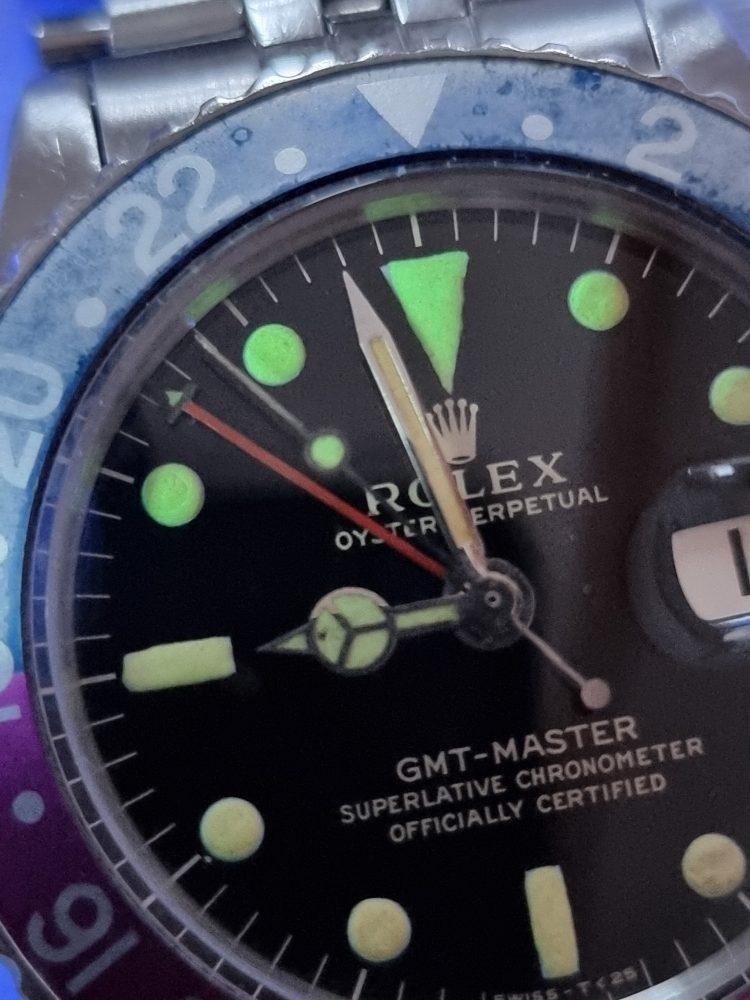
Rolex GMT-Master Ref. 1675. Designed with commercial pilots in mind, matte-dial examples use large tritium plots and are signed "SWISS - T < 25." Untouched plots are flat and matte, and they age into a creamy ivory or a rich "pumpkin" orange.
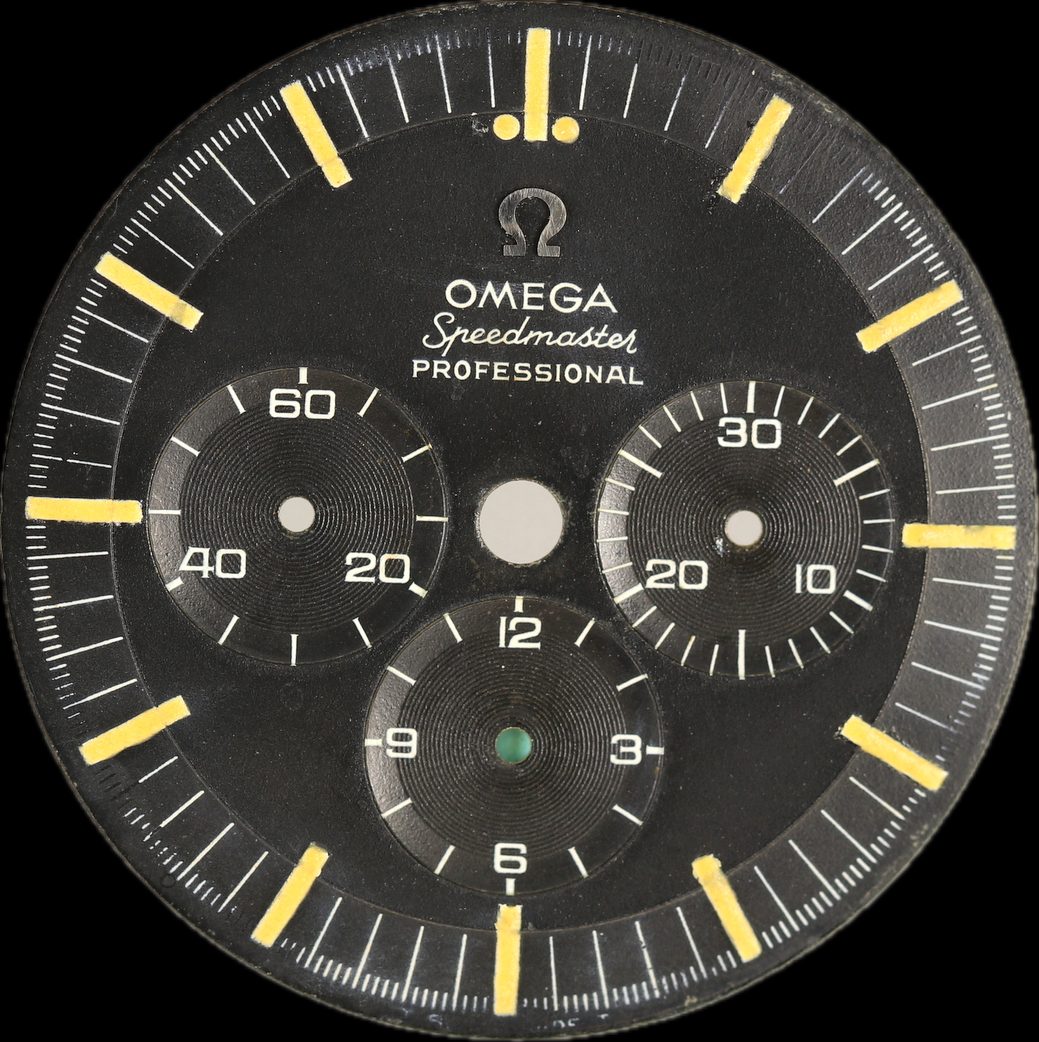
Omega Speedmaster Professional Ref. 145.022 (1968 to 1988). These carry tritium dials marked with the lower limit, usually "T SWISS MADE T." Speedmaster lume was applied thinly, so it tends to age into a lighter sandy cream rather than a deep orange. The 145.022 also went through several dial versions over its twenty-year run: an early stepped dial, a later flat dial, and changes in how the T marks were printed and spaced. Know which dial is right for your watch's suffix and serial. Many have also had their dials replaced during an Omega service with a later service dial, so check the dial against the watch's age.
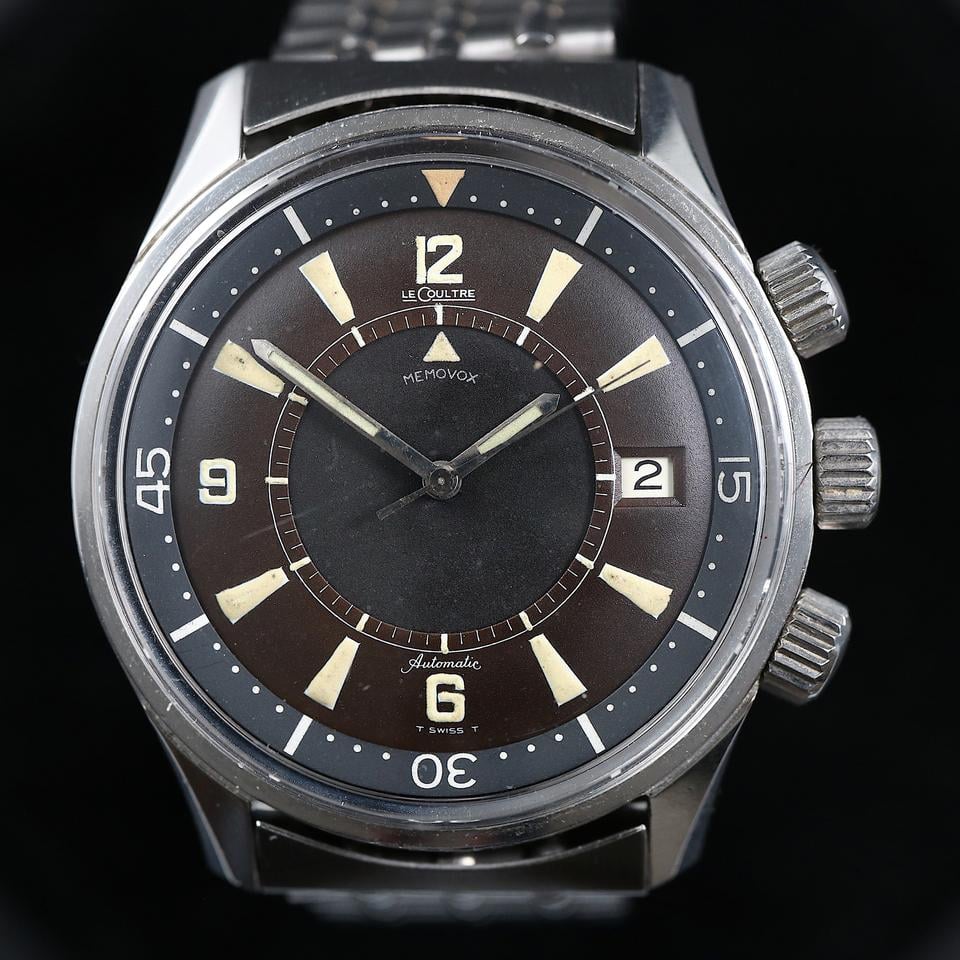
Jaeger-LeCoultre Memovox Polaris Ref. E859 (1965 to about 1970). This is one of the great vintage alarm divers, with fewer than about 1,700 made in total. Collector research puts it at roughly 500 in the first 1965 series, a 1968 series of over 1,200, and a short Calypso run around 1970. The Polaris used tritium from the start, and correct dials are signed "T SWISS T" or "T SWISS MADE T." The later matte dials have very large lume plots that are prone to flaking, so dials that are both original and intact are hard to find.
How do collectors get fooled?
A lot of collectors buy a watch they think is all original, then find out later that its value took a hit. Two traps come up again and again.
Trap 1: The factory service dial
This one has nothing to do with a back-room relume. It happens when a vintage watch goes back to the manufacturer for a routine overhaul. Brands service for function, so if they see dead tritium, they often replace the original dial and hands with new parts that use modern Super-LumiNova.
Those parts are genuine, made by the brand and fitted by the brand. That's why collectors miss it. A factory service receipt sounds reassuring, but a vintage watch with a modern service dial is worth far less than one with its original dial, often much more than the cost of the service. On a sought-after reference the difference can run into the thousands.
Rolex is the classic example. When a vintage Rolex comes in for service, Rolex often swaps original patinated dials, hands and bezels for clean new parts, and it keeps the parts it removes. If it decides an original part isn't up to standard, that part is likely scrapped, so the original dial is gone for good. Plenty of desirable vintage Rolexes have lost their character this way, with warm original patina replaced by parts that look brand new.
If you send a vintage watch in, tell the service center in writing, before any work starts, that the original dial, hands and bezel must stay on the watch, and ask for any replaced parts to be returned to you.
Trap 2: Relumes
A relume is different from a service dial. It's when anyone outside the factory, from a skilled restorer to a hobbyist with a syringe, scrapes off the old lume and applies new paint. It's the most common reason for that 30% to 50% loss in value, and good relumes can be hard to spot. The tests below are how you find them.
"Tritinova": a niche worth knowing
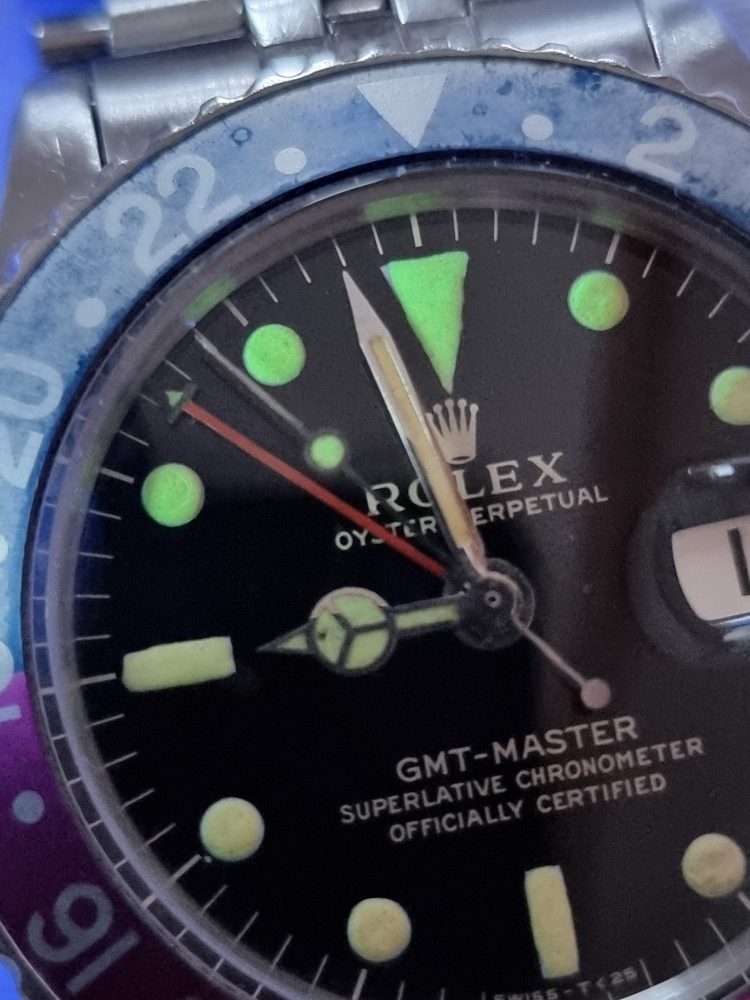
In the late 1990s, the industry switched from tritium to non-radioactive LumiNova. For a short time, factories still had dials that were already printed "T SWISS T," so they filled them with LumiNova and used up the stock. Collectors call these "Tritinova" dials. You'll mostly hear the term with late-90s Rolex sports models, like the Explorer II 16570.
So the dial says tritium, but it glows bright green under UV like a modern watch, and it will never develop the warm patina that tritium does.
Collectors are split on them:
Against: some see a mismatch between what the dial says and what's on it, and they price Tritinova dials below proper tritium dials.
For: a growing group collects them on purpose as a short transitional period, the last dials printed for tritium but made in the LumiNova era. Dealers increasingly list them by name as a selling point.
Either way, a Tritinova dial isn't a fake or a service replacement. It's a genuine factory variation, but you should know what you're buying and price it as what it is.
Fake and forged lume
As vintage prices climb, forgers have gotten much more careful. Here are three techniques to know.
Lume slurry touch-ups. As tritium ages, it turns powdery and chalk-like. Some sellers collect original tritium from damaged dials, mix it with a modern clear binder or matte glue, and use it to rebuild a crumbling plot or hand. To the naked eye, the color can match perfectly.
Baking and chemical aging. To fake the much-wanted "pumpkin" patina, forgers take modern white Super-LumiNova and age it in an oven, or stain it with chemical vapors, tea or coffee. This mimics decades of aging in a few hours.
Overpainting dead plots. High-end forgers use precise pad printers or fine syringes to lay new, artificially aged compound directly over original plots and hands. The result can make a tired watch look like new old stock.
How to check lume before you buy
Before buying any expensive vintage watch, run it through these four checks.
1. The UV test
Shine a 365nm UV flashlight on the dial for five seconds, then turn it off. Original radium or tritium should stay dark, or give off a weak glow that fades within seconds. If the markers stay lit, the lume is modern.
Also look at how the plots react while the light is on. Original tritium tends to react evenly. If someone used lume slurry with a modern binder, the glue often glows a different color, usually purple or blue.
2. The Geiger counter test
This is the best way to check for radium, and a basic counter doesn't cost much. Radium stays radioactive for centuries, long after its glow has died. Its radiation passes straight through the crystal and case, so a counter held over the dial will click well above background.
Tritium is different. Its radiation is too weak to get through the crystal, and it has a half-life of about 12 years, so a tritium watch from the 1960s to 1990s should read at or near background.
That makes the Geiger counter especially useful for watches from the early 1960s changeover years:
A strong reading on a watch whose dial says T SWISS T, or one from a period that should be all tritium, suggests radium hands or a radium dial from another watch.
A watch that should be radium but reads at background has probably had its dial or hands replaced or relumed.
Hands and dial should read the same. One hot and one quiet means parts from different watches.
A safety note: radium is a real health risk if it's breathed in or swallowed. Don't open a watch with flaking radium lume or scrape at it. Leave that to a watchmaker set up to handle it.
3. A close look under a 10x loupe
Original plots were applied by hand or pad-printed. Under a loupe, aged originals show slight shrinkage, tiny cracks or flaking, and an uneven, grainy, chalky surface. If the plots look perfectly even and centered, glossy and domed like a drop of gel, be very suspicious.
4. Do the dial and hands match?
The hands and the dial lived the same life, so their lume should look alike in color and in aging.
If an early-1960s sports watch has cream markers on the dial but bright white hands, or a 1950s dress watch has a faded dial but clean, greenish hands, parts have been replaced or reworked.
Why should we care about lume?
In the end, checking lume isn't about squinting at old paint or ticking boxes on a certificate. It's about knowing what you're holding.
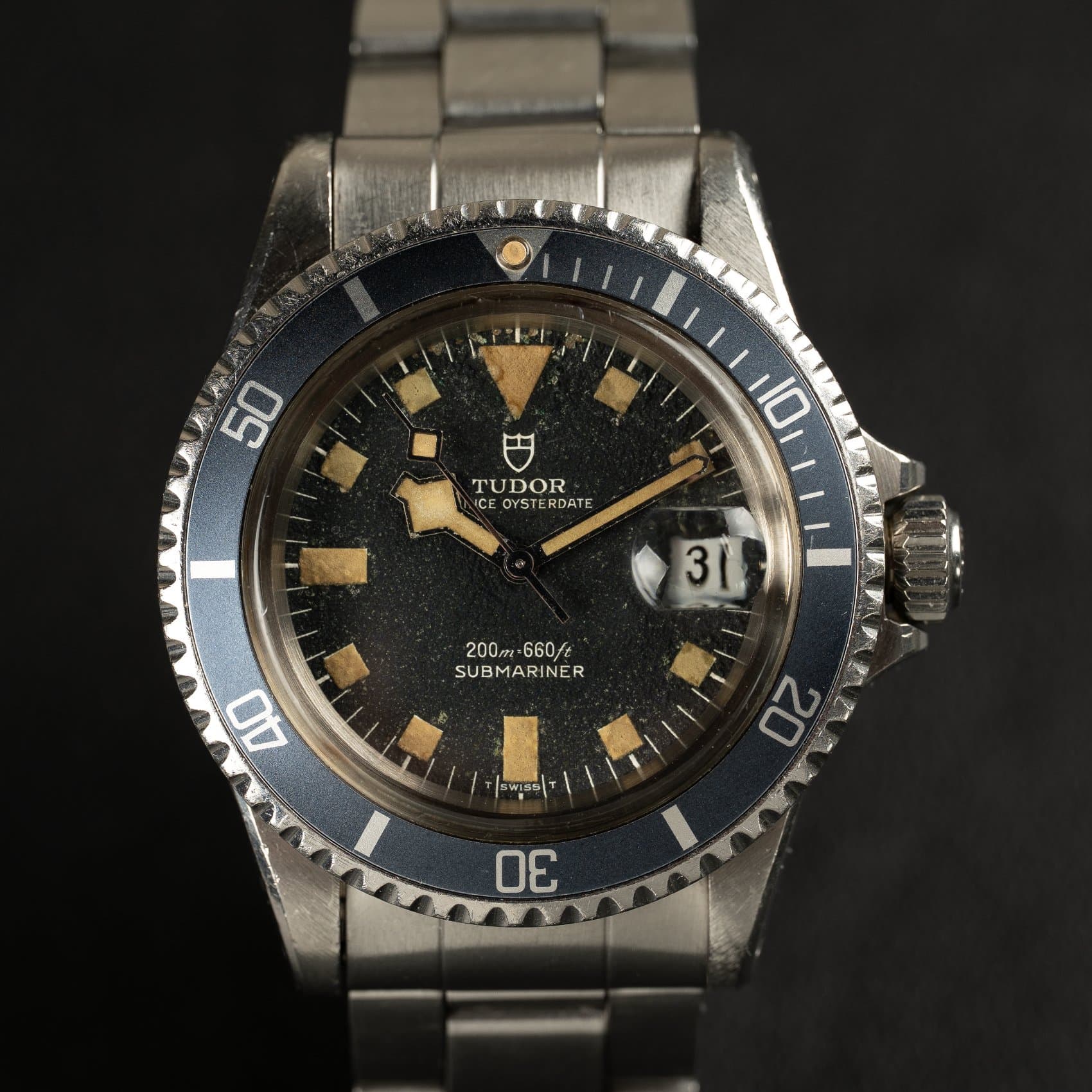
The color of the lume is a record of the paint used, how much was applied, and what the watch went through. A deep amber Submariner and a pale cream Speedmaster aren't better or worse than each other. They used different compounds, applied in different amounts, and lived different lives in different amounts of sun, heat and humidity. The cracks, the color shifts and even the dead glow are all part of that record. When the lume is original, the watch still tells you how it lived.
Randy bought his first vintage watch at twenty five, a gold-plated Gruen Precision, because he thought James Bond was cool and could not afford the solid gold Omega Seamaster his grandfather wore. Decades later he deals in the pieces he once could not afford. He is Vice President of Biel Vintage Watches, working with first-time buyers and seasoned collectors alike. No hype, no pressure, no nonsense.